FIRST Tech Challenge 2025–26: Regional Championship and Qualification
- 15 Feb, 2026
- Chaitanya
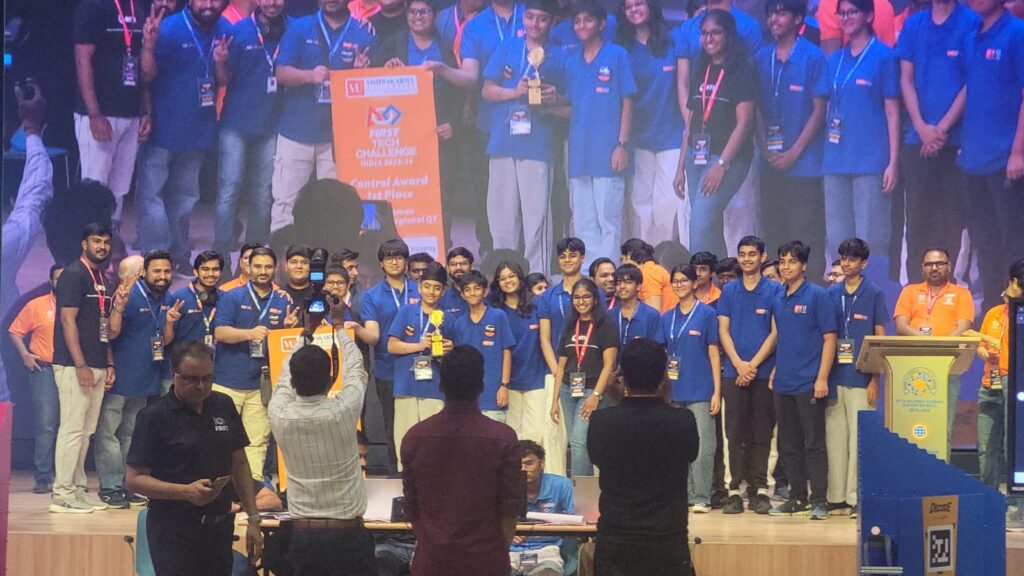
Participation in the FIRST Tech Challenge (FTC) has been a significant component of my academic and technical development this year. The competition provided an opportunity to apply principles of robotics, automation, and systems thinking in a real-world, high-pressure environment while working within a multidisciplinary team.
Regional Championship Performance
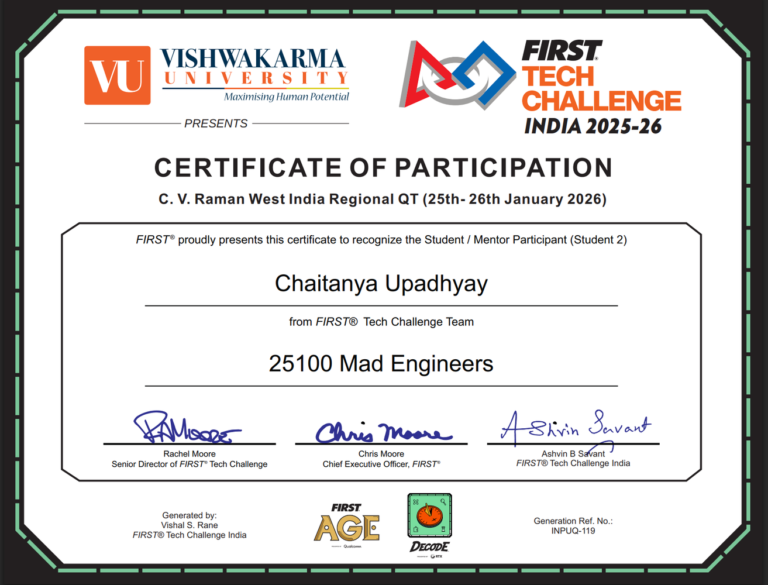
As part of Team Mad Engineers, I participated in the C. V. Raman West India FIRST Tech Challenge Regional Championship. The event brought together leading FTC teams from the region and evaluated performance across robot design, control systems, documentation, teamwork, and outreach.
At the conclusion of the championship, our team was awarded the Control Award, which recognises excellence in software architecture, automation, sensor integration, and control systems engineering. This award is presented to teams that demonstrate robust, reliable, and well-documented control strategies rather than isolated technical features.
Based on this achievement, Team Mad Engineers qualified to advance to the FIRST Tech Challenge India National Championship.
My Role and Responsibilities
Within Team Mad Engineers, I serve as the Social Media Manager and Outreach Coordinator, a role focused on structured communication, documentation, and community engagement. My responsibilities span technical documentation, outreach planning, and external representation of the team’s work.
Technical Documentation and Portfolio Support
- Documenting the team’s engineering journey across the season, including design iterations, automation strategies, and competition milestones
- Assisting in the preparation of portfolio content and written submissions for FTC judging
- Ensuring that technical decisions are explained clearly, logically, and with appropriate context
- Supporting the organisation and presentation of material that demonstrates consistency, reliability, and systems-level thinking
Outreach and Community Engagement
- Supporting the planning and coordination of outreach initiatives aimed at promoting robotics and STEM education
- Assisting in workshops and engagement activities designed to introduce younger students to robotics concepts
- Helping communicate the purpose and impact of the FIRST Tech Challenge beyond competition results
- Adapting technical explanations to suit non-technical audiences while maintaining accuracy and intent
Communication and External Representation
- Managing how the team’s work and progress are represented across digital platforms
- Prioritising professional, accurate, and responsible communication over promotional visibility
- Highlighting learning outcomes, teamwork, and problem-solving processes rather than isolated achievements
- Ensuring alignment with the values of the FIRST ecosystem, including professionalism and gracious conduct
Technical Exposure and Systems Understanding
- Actively participating in discussions related to automation logic, control systems behaviour, and match strategy
- Observing how software architecture and sensor feedback translate into real-time robot performance
- Developing a systems-level understanding of robotics, particularly the interaction between software and hardware
- Strengthening analytical thinking relevant to robotics, artificial intelligence, and bioengineering applications
Skills and Learning Outcomes
- Structured technical communication and documentation
- Interpretation of complex engineering decisions for diverse audiences
- Collaborative problem-solving within a multidisciplinary team
- Accountability and precision in high-stakes, time-constrained environments
Significance of the Control Award
The Control Award evaluates how effectively a robot operates as an integrated system. This includes the use of sensors, feedback mechanisms, automation routines, and driver-assist features that improve consistency and reduce error during matches.
Preparing for this aspect of the competition reinforced the importance of structured problem-solving, documentation, and iterative testing. The process highlighted how disciplined engineering practices lead to reliability under competition conditions, a principle that is equally relevant in research-oriented and real-world engineering applications.
Mentorship and Training Environment
Our preparation and competition journey have taken place under the supervision of mentors from OMOTEC Technology Institute, where we receive structured and advanced robotics training. Mentor guidance emphasised clarity of reasoning, justification of design decisions, and systematic evaluation of failures and improvements.
This mentorship environment encouraged critical thinking and accountability, shaping how I approach technical challenges beyond the competition itself.
Preparing for the National Championship
Qualifying for the National Championship represents an important milestone, but it also marks the beginning of a more demanding phase. The focus moving forward is on improving system reliability, strengthening documentation, and refining communication of our engineering decisions.
This first phase of the FTC season has provided valuable exposure to collaborative engineering, competitive evaluation, and professional standards of technical work. The next phase will involve applying these lessons at a national level.
Related Posts

The Importance of Asking Better Questions in Science 8 Oct, 2026 Chaitanya I have started…
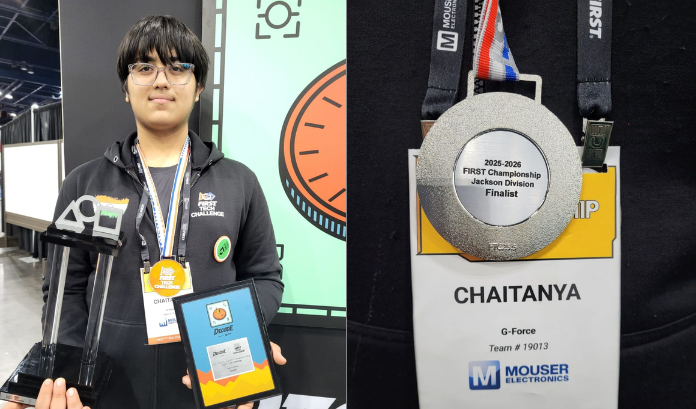
Finalists of FIRST TECH CHALLENGE 7 May, 2026 Chaitanya Proud to share that our team,…
Why Bioengineering Needs Both Code and Curiosity 28 April, 2026 Chaitanya When I first started…